Why Defensible Space Is the First Line of Defense
Defensible space is the most underrated piece of wildfire-resilience design, and it's the one most homeowners don't fully understand until late in the design process. The way I think about it is simple: the building envelope is the second line of defense against wildfire. The first line is the landscape immediately around the home. If a fire never reaches the structure, the structure never has to perform under emergency conditions.
The five feet closest to the home are the most consequential five feet on the entire property, and the design discipline around that area changes everything about how a fire-resilient home actually performs. This post is the practical guide to defensible space in Oregon — what each zone requires, what plants actually work in our climate, and how the landscape integrates with the architecture from the very first sketch.
The Three-Zone Framework
Defensible space is organized as three concentric zones around the home, and the discipline at each zone is different. Zone 0 extends from zero to five feet from any structure (including outbuildings, decks, and ADUs). Zone 1 extends from five feet to thirty feet. Zone 2 extends from thirty feet to one hundred feet, or to the property line if it's closer.
The principle that organizes all three is fuel reduction — making sure that combustible material is reduced or eliminated as you get closer to the building, with the highest discipline at the immediate perimeter and progressively more relaxed as you move outward. The zones are not arbitrary code minimums. They're the design framework that decides whether a wildfire can reach the structure at all, and they're increasingly mandated by Oregon counties in designated wildland-urban interface zones.
Zone 0: The Hardest Five Feet on Your Property
Zone 0 is the hardest five feet on your property to get right, and it's the place where most homes (and most landscape designs) fall short. The rule for Zone 0 is that nothing combustible should be within five feet of any structure. That means no woody plants, no wood mulch, no flammable mulches, no wood fences that abut the home, no firewood stacks, no propane tanks within reach of the building, and no plastic patio furniture stored against an exterior wall.
What replaces it is inert hardscape: gravel, decomposed granite, flagstone, concrete, brick, or slate. The transition from the home's foundation outward should be a hardened band that an ember landing in it cannot ignite. Within that hardened band, you can include non-combustible elements like metal planters with succulents (which are essentially fire-resistant), low concrete benches, or stone water features. The design opportunity is real — Zone 0 doesn't have to be a sterile gravel apron — but the discipline cannot bend.
Common Zone 0 Mistakes
Common Zone 0 mistakes I see on Oregon homes: wood-chip mulch right against the foundation. Boxwood or arborvitae hedges planted within five feet of the building. Cedar or redwood deck attachments without underside screening. Wood lattice fence panels meeting the house wall. Bark beauty bark in flower beds at the base of the home. Vines climbing exterior walls. Any of these turn the immediate perimeter into a fuel concentration that makes the rest of the resilience strategy substantially less effective. The fix is not difficult — it's a design discipline applied early — but the retrofit is more expensive than getting it right on day one.
Zone 1: Fire-Resistant PNW Plant Palettes
Zone 1 is where the design language broadens. Five to thirty feet from the home, the discipline shifts from "no combustible material" to "fire-resistant species, properly spaced." The plants that work in Zone 1 in Oregon are typically native, drought-tolerant species with high moisture content, low resin content, and growth habits that don't ladder fire upward into trees or onto the building.
A good Zone 1 plant palette for the Willamette Valley and Coast Range includes Pacific manzanita (Arctostaphylos columbiana), evergreen huckleberry (Vaccinium ovatum), salal (Gaultheria shallon) used judiciously, Oregon grape (Mahonia aquifolium), kinnikinnick (Arctostaphylos uva-ursi), native bunchgrasses like Roemer's fescue and California oatgrass, and native ferns like deer fern and sword fern in shaded zones. Coreopsis, yarrow, sedum, and lavender all work well as fire-resistant flowering accents. The spacing matters as much as the plant choice — individual plants and small clusters separated by hardscape or low ground cover, rather than continuous masses that allow fire to spread laterally.
Trees in Zone 1: Where Conifers Belong
Trees in Zone 1 require careful thought. The general principle is that no tree canopy should be within ten feet of the home, no canopy should overhang the roof, and tree limbs should be pruned up to at least six to eight feet above the ground to prevent fire-ladder progression from grass into the canopy. Native Oregon white oak (Quercus garryana) is one of the more fire-tolerant native trees and a good Zone 1 candidate at appropriate distance.
Pacific madrone is also fire-tolerant. Conifers — Douglas fir, western hemlock, western red cedar — are higher fire risk because of their resin content and crown structure, and they should be located in Zone 2 rather than Zone 1 wherever possible. Deciduous trees with low resin content are generally safer than conifers in Zone 1.
Zone 2: Fuel Reduction at the Outer Perimeter
Zone 2 is the outer perimeter, thirty to one hundred feet from the home. The discipline here is fuel reduction rather than elimination — managing the existing landscape so a wildfire approaching the property has less to burn as it gets closer. That means thinning dense vegetation, removing dead and downed wood, pruning lower limbs on conifers, breaking up continuous brush with hardscape or fire-resistant ground cover, and maintaining clear separation between tree canopies so a crown fire can't sustain itself across the property.
On rural Oregon acreage, Zone 2 often extends well beyond a hundred feet — wherever the wildland edge meets the developed area. The maintenance schedule for Zone 2 is real and ongoing: annual brush clearing, periodic tree limb work, and continuous monitoring of fuel loads.
How Defensible Space Integrates with the Architecture
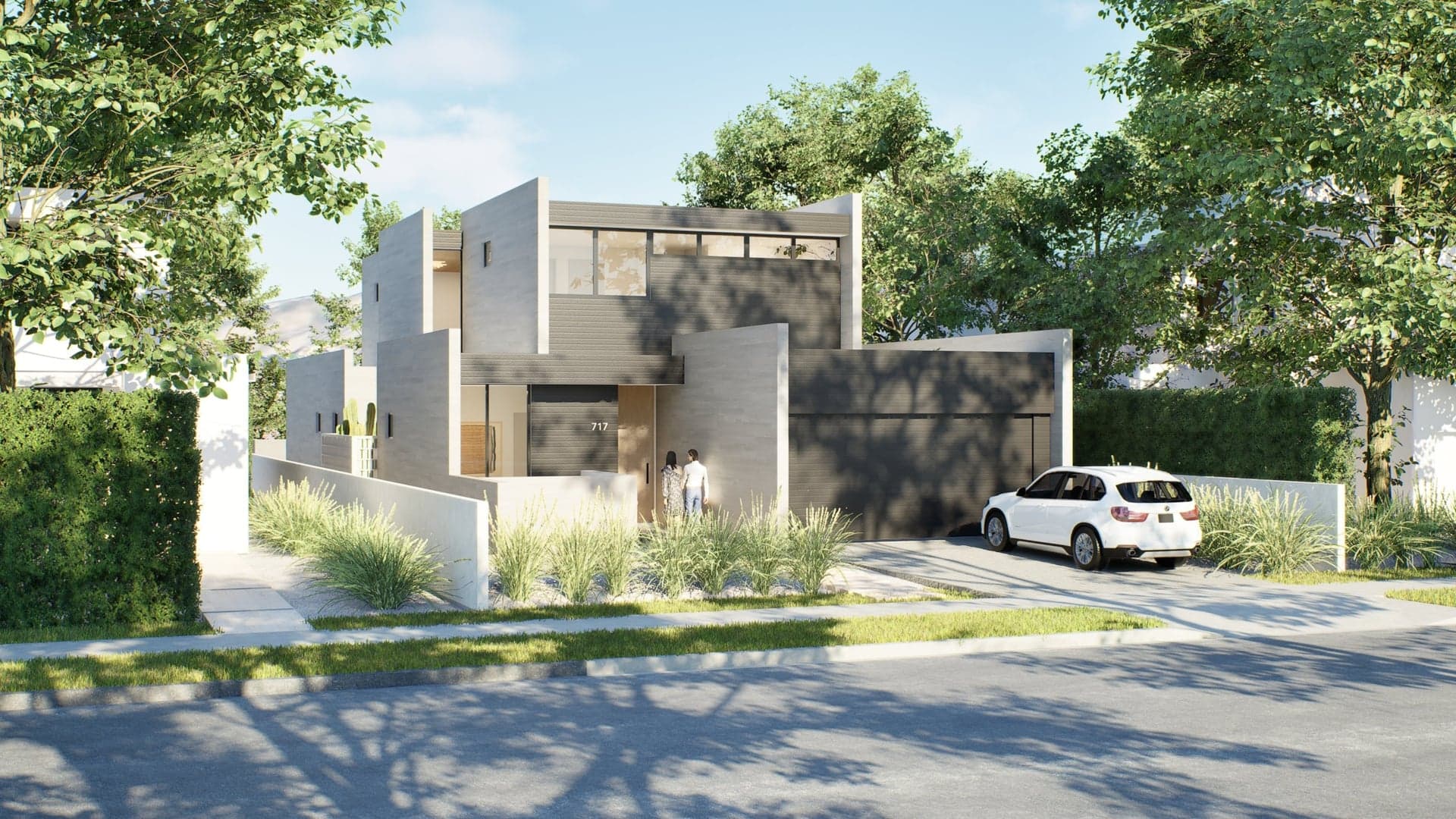
How defensible space integrates with the architecture is what separates good wildfire-resilient design from a collection of unrelated decisions. The Case Study Adapt program has demonstrated this consistently. The Bramell House (CSA #1) by Woods + Dangaran reduces eaves and decks to the minimum the design requires and pairs that with a defensible space strategy that makes the building's geometry and the landscape's discipline work together.
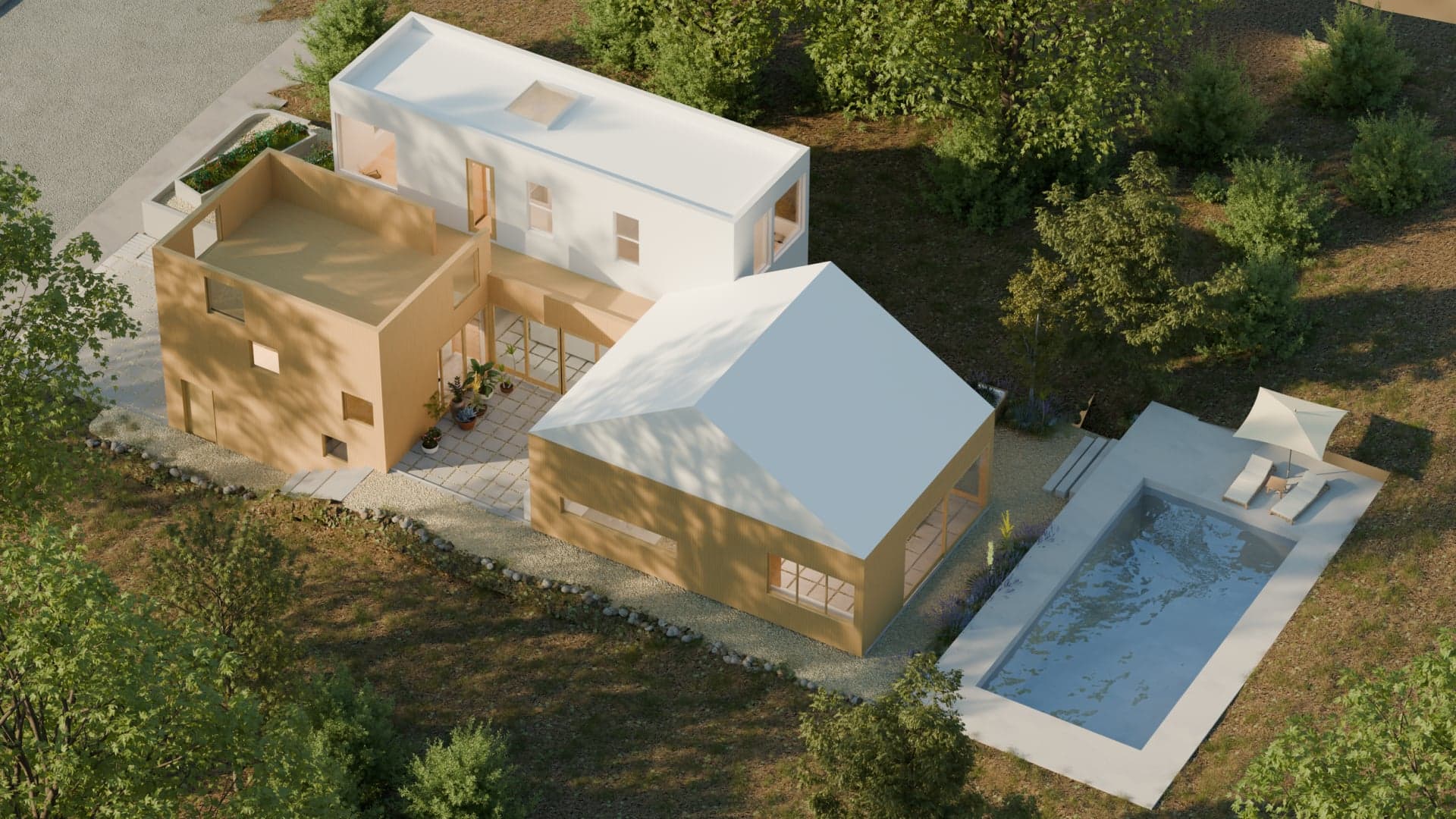
The Childers House (CSA #3) by Bestor Architecture treats the swimming pool as a fire-suppression water reserve and integrates native vegetation into a permeable hardscape system that handles fire and water management as one strategy. The Rafferty House (CSA #5) by Montalba Architects makes the five-foot vegetation-free perimeter a design discipline rather than a code minimum. The pattern across all sixteen CSA projects is the same: defensible space is not a landscape afterthought, it's a design problem solved alongside the architecture from the first sketch.
What Creekside Builds Into Every Project Now
What we've started doing on every Creekside Homes project — including projects on lots that aren't in formally designated wildland-urban interface zones — is treat the defensible space conversation as part of the schematic design phase. The five-foot Zone 0 perimeter is laid out before the floor plan is finalized. Zone 1 plant palette options are presented to the client during finish selection.
Zone 2 management plans are documented for ongoing maintenance. Outdoor structures (sheds, ADUs, deck additions) are sited with their own Zone 0 considerations rather than assumed to be exempt. The maintenance schedule is part of the homeowner handover documentation. This is how serious wildfire-resilient residential design actually works in practice, and it's becoming the baseline rather than the upgrade.
How to Get a Defensible Space Plan for Your Lot
If you own land in a designated wildland-urban interface zone — or in any rural part of Yamhill, Polk, Washington, Clackamas, Tillamook, Lincoln, or Lane County where the wildfire conversation now applies — and you're thinking about a custom home, the defensible space conversation should be part of the very first design meeting. Most of our clients in the last few years have started with a paid site evaluation that includes a fire-exposure assessment, a defensible-space layout for their specific lot, and a recommended plant palette tailored to the site's microclimate.
The contact form on this site or a direct call to (503) 461-7046 is the easiest way to start. The principles travel — to coastal sites, to foothill builds, to rural acreage in wine country — and the discipline they require shows up in the architecture, the landscape, and the way the home actually performs over its lifetime.
Frequently Asked Questions
What is defensible space and why does it matter in Oregon?
Defensible space is the layered landscape strategy around a home designed to slow or stop a wildfire from reaching the structure. It is organized as three zones: Zone 0 (zero to five feet, no combustible material), Zone 1 (five to thirty feet, fire-resistant native plants properly spaced), and Zone 2 (thirty to one hundred feet, reduced fuel loads). It matters because the building envelope is only the second line of defense; the first line is the landscape immediately around the home. If a fire never reaches the structure, the structure never has to perform under emergency conditions.
What is Zone 0 and what should it contain?
Zone 0 is the area within the first five feet of any structure on the property — including the main residence, ADUs, sheds, and decks. The rule is that nothing combustible should be within Zone 0. That means no woody plants, no wood or bark mulch, no wood fences abutting the home, no firewood stacks, no plastic patio furniture stored against exterior walls, and no propane tanks within reach. What replaces it is inert hardscape: gravel, decomposed granite, flagstone, concrete, brick, or slate. Non-combustible elements like metal planters with succulents, low concrete benches, or stone water features are acceptable.
What are the best fire-resistant plants for Oregon?
For Zone 1 in the Willamette Valley and Coast Range, native drought-tolerant species with high moisture content and low resin work best: Pacific manzanita (Arctostaphylos columbiana), evergreen huckleberry, Oregon grape (Mahonia aquifolium), kinnikinnick, native bunchgrasses like Roemer's fescue and California oatgrass, and native ferns. Coreopsis, yarrow, sedum, and lavender work well as fire-resistant flowering accents. Spacing matters as much as plant choice — individual plants separated by hardscape rather than continuous masses.
Which trees are safe to plant near my home in Oregon?
Native Oregon white oak (Quercus garryana) and Pacific madrone are among the more fire-tolerant native trees and good candidates for properly-spaced Zone 1 placement. Conifers (Douglas fir, western hemlock, western red cedar) are higher fire risk due to resin content and crown structure and should be located in Zone 2 rather than Zone 1. No tree canopy should overhang the roof or come within ten feet of the home, and tree limbs should be pruned up six to eight feet above the ground to prevent fire-ladder progression.
Is defensible space required by law in Oregon?
Requirements vary by jurisdiction. Oregon Department of Forestry maintains baseline defensible space standards, and many counties — including Yamhill, Polk, Tillamook, Lincoln, Lane, and Jackson — have updated codes that mandate defensible space practices in designated wildland-urban interface zones. Senate Bill 762 (2021) established statewide wildfire risk mapping and is driving expanded enforcement. Even where not formally required, defensible space is increasingly a factor in insurance underwriting and rates.
Can I have wood mulch in my landscape if I live in a fire-prone area?
Not in Zone 0. Wood and bark mulches are among the most consequential ignition risks in defensible space planning, and they should not be used within five feet of any structure. In Zone 1, gravel mulch, decomposed granite, or low-flame ground covers are preferred over wood-based mulches. In Zone 2, wood mulch in moderate amounts is generally acceptable if it's kept well away from structures and broken up with hardscape.
How much does defensible space landscaping cost in Oregon?
A defensible-space landscape design and installation for a typical residential lot in Oregon in 2026 runs roughly $5,000 to $25,000 depending on lot size, the extent of hardscape required in Zone 0, and the plant palette in Zone 1. Larger rural acreage with significant Zone 2 brush management can cost more. The investment is meaningful but is a fraction of the cost of losing the home, and increasingly affects insurance availability and rates regardless.
Do I need defensible space if my home isn't in a designated WUI zone?
It's increasingly worth treating defensible space as baseline regardless of formal designation. Many parts of Oregon that aren't yet in designated wildland-urban interface zones are likely to be added as risk mapping continues to expand under Senate Bill 762. Insurers are also increasingly factoring defensible space into underwriting decisions even on properties not formally designated. From a design perspective, defensible space is good landscape practice whether it's required or not.
Can defensible space be beautiful?
Yes — and the Case Study Adapt program demonstrates this consistently. The Rafferty House by Montalba Architects, the Childers House by Bestor Architecture, and the Bramell House by Woods + Dangaran all integrate defensible-space discipline with extraordinary residential landscape design. Zone 0 hardscape can be sculpted, textured, and beautiful. Zone 1 plant palettes can be lush, colorful, and seasonal. Treating defensible space as a design problem solved alongside the architecture — rather than a code minimum applied afterward — produces some of the most compelling residential landscapes available.
How do I get a defensible space plan for my Oregon property?
Several paths. Oregon Department of Forestry and many county conservation districts offer free or low-cost defensible space assessments for homeowners. Landscape architects experienced in fire-resilient design can produce comprehensive plans tailored to your specific lot. For a builder's read on how the landscape should integrate with the architecture, a paid site evaluation from a builder experienced in wildland-urban interface construction — typically $3,000 to $8,000 — provides comprehensive guidance specific to your property and the home you want to build.
The Building Journey
See how we design and build your home, step by step.
Floor Plans
Browse 15 customizable designs from 1,635 to 5,628 sq ft.
Service Area
We build across Yamhill County, Sherwood, Hillsboro, and wine country.
Ready to Talk About Your Project?
Get expert guidance from Oregon's trusted custom home builder.