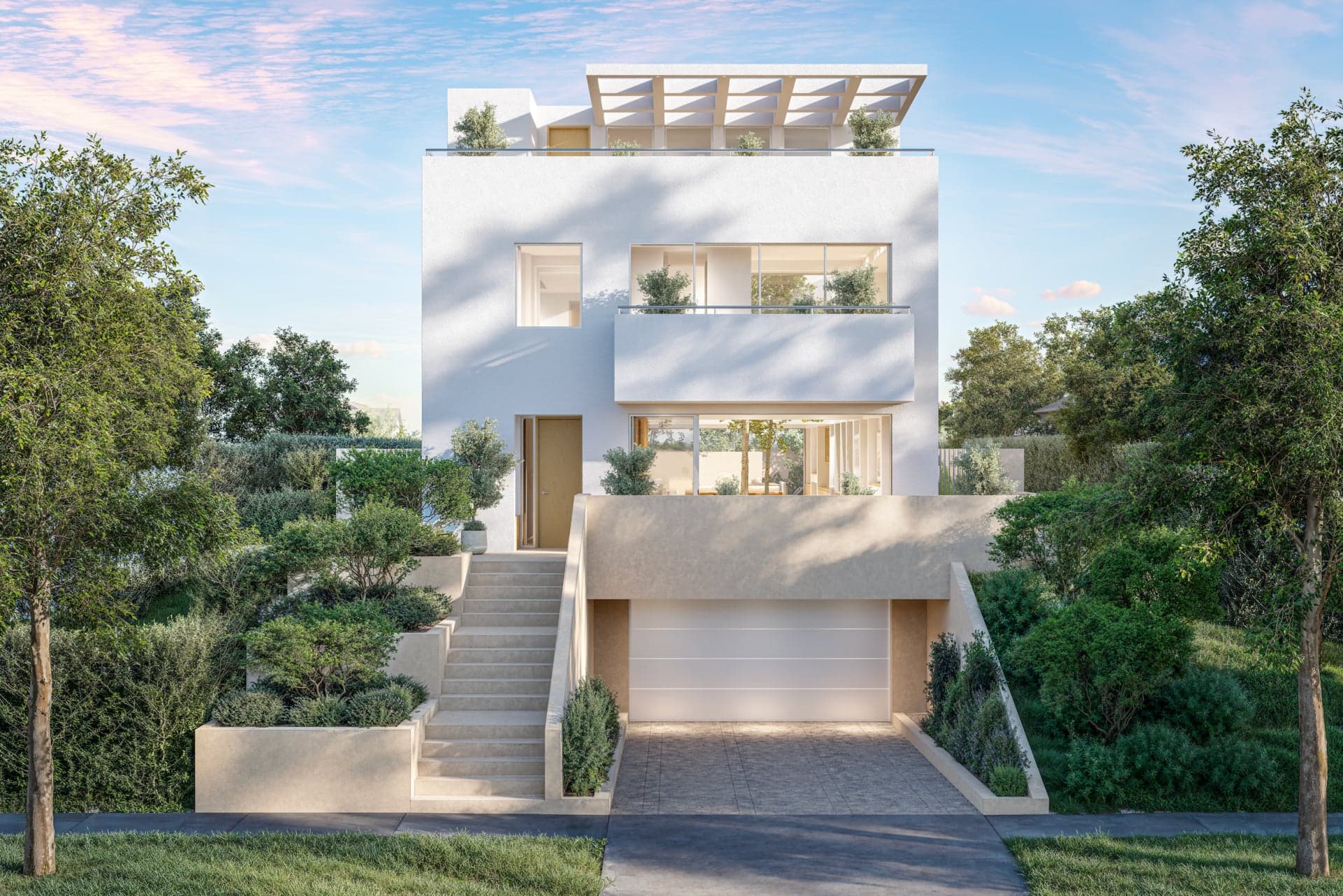
Seven Houses In, Inventive in the Best Sense
Seven houses in. Some of the Case Study Adapt projects refine accepted approaches. CSA #7 — the Schaffer-Balsley House by von Oeyen Architects — proposes something different. Geoffrey von Oeyen has inverted the usual relationship between building and landscape, bringing the trees inside the home rather than placing them around it. A tall, sun-lit atrium becomes the residence's central grove — a protected interior forest that earns its existence in several ways at once. I am calling this inventive, and I am using that word carefully because most 'inventive' residential design is decorative novelty rather than structural intelligence. This one is the opposite.
An Atrium That Does Multiple Jobs
The first job that atrium does is fire safety. Trees inside the building envelope are sheltered from wildfire risk in a way exterior planting can never be. The second job is environmental: the atrium operates as a solar chimney, drawing warm air upward and pulling cool sea breezes through the living spaces below. The home cools itself, gracefully, and the natural-ventilation diagram is doing the work that mechanical air conditioning usually has to. One architectural feature, multiple functions — that is the discipline I respect most across this entire program, and the Schaffer-Balsley House gets it right at the boldest scale we have seen yet.
A Section Designed Around How Light Moves Through Leaves
The section is the other star of the project. Three levels step inward as they rise, opening shaded outdoor terraces with mountain and ocean views at each landing. Every level looks down into the atrium canopy, where filtered light through the foliage animates the interiors with the kind of dappled, alive quality that no skylight detail can fake. The home is essentially designed around how light moves through leaves. That is a surprisingly old idea — Wright's prairie houses and the best Japanese residential traditions have explored it for a century — but applying it inside a modern fire-resilient envelope is a fresh, ambitious move. The architectural lineage runs deeper than the rendering style suggests.
Self-Contained Fire Protection, Designed In
The pool, as in several other Case Study Adapt projects, has been pulled into the resilience strategy. It serves as both a recreational amenity and a water reserve for roof-mounted sprinklers — powered by photovoltaic panels above the atrium during a wildfire emergency. That is a self-contained protection system, and it is exactly the kind of integrated thinking the wildland-urban interface era is going to demand from residential architects everywhere. The lesson scales: you can ask the same set of resources — pool, solar, plantings — to handle multiple roles when the design approaches the home as a system rather than a sum of features.
Inventive, Not a Stunt
Von Oeyen Architects has been doing thoughtful, formally inventive work for years, and the Schaffer-Balsley House is one of the more ambitious projects in this series. It would be easy to read it as a stunt — bringing the forest inside the house. The opposite is true. Every move is doing structural, environmental, and experiential work simultaneously. That is the discipline good architecture has always asked for, and watching it play out in this project gives me real optimism about what the next generation of California residential work is going to look like.
Lessons That Travel
Seven houses in, the Case Study Adapt program is delivering exactly the kind of high-level design conversation it was meant to deliver. The Schaffer-Balsley House sits at the more ambitious end of the spectrum so far, but its ambition is earned, and the lessons it offers about integrated design thinking will travel well beyond Pacific Palisades. Read the full project on Case Study Adapt: https://www.casestudyadapt.org/houses-in-development/project-six-sz8wl-d64c9-gb95m-ndyde-rmlbl-zh6t4-n4bst.
Frequently Asked Questions
What is the Schaffer-Balsley House?
The Schaffer-Balsley House is the seventh project in the Case Study Adapt series — a three-level residence by Los Angeles firm von Oeyen Architects. The home's defining gesture is a tall, sun-lit interior atrium with mature trees inside the building envelope. The atrium operates simultaneously as a fire-protected interior grove, a solar chimney that drives natural ventilation, and the project's primary daylight source.
What is a solar chimney in residential architecture?
A solar chimney is a vertical, sun-warmed shaft inside a building that creates an upward draft by heating the air at its top. As warm air rises and exits, it pulls cooler air in from openings at the bottom, driving passive cross-ventilation through the rest of the home. Solar chimneys are one of the more elegant tools in the passive-cooling design tradition and can dramatically reduce mechanical air-conditioning load when the architecture is designed around them.
Why bring trees inside a fire-resilient home?
Trees inside the building envelope are sheltered from wildfire risk in a way exterior planting cannot be — there is no defensible-space conflict, no ember exposure, and no fuel load near the structure. When the interior atrium is also doing environmental work like driving natural ventilation, the architectural move pays for itself multiple times over. The Schaffer-Balsley House is one of the boldest demonstrations of this idea in the Case Study Adapt program.
Who are von Oeyen Architects?
von Oeyen Architects is a Los Angeles–based residential firm led by Geoffrey von Oeyen. Their portfolio is known for formal inventiveness paired with rigorous environmental performance. They have two contributions to the Case Study Adapt series — the Schaffer-Balsley House and the Fairbairn-Ratsch House — both of which carry forward the interior-atrium move at different scales and on different sites.
Can a solar chimney work in the Pacific Northwest climate?
Yes, with thoughtful detailing. Solar chimneys are most effective when the home needs cooling, which in the Pacific Northwest means summer afternoons and increasingly long summer heat events. The volume, shading, and coupling with the rest of the natural-ventilation strategy all need to be tuned to the local climate. The principle absolutely travels — the execution has to be specific to the site.
The Building Journey
See how we design and build your home, step by step.
Floor Plans
Browse 15 customizable designs from 1,635 to 5,628 sq ft.
Service Area
We build across Yamhill County, Sherwood, Hillsboro, and wine country.
Ready to Talk About Your Project?
Get expert guidance from Oregon's trusted custom home builder.