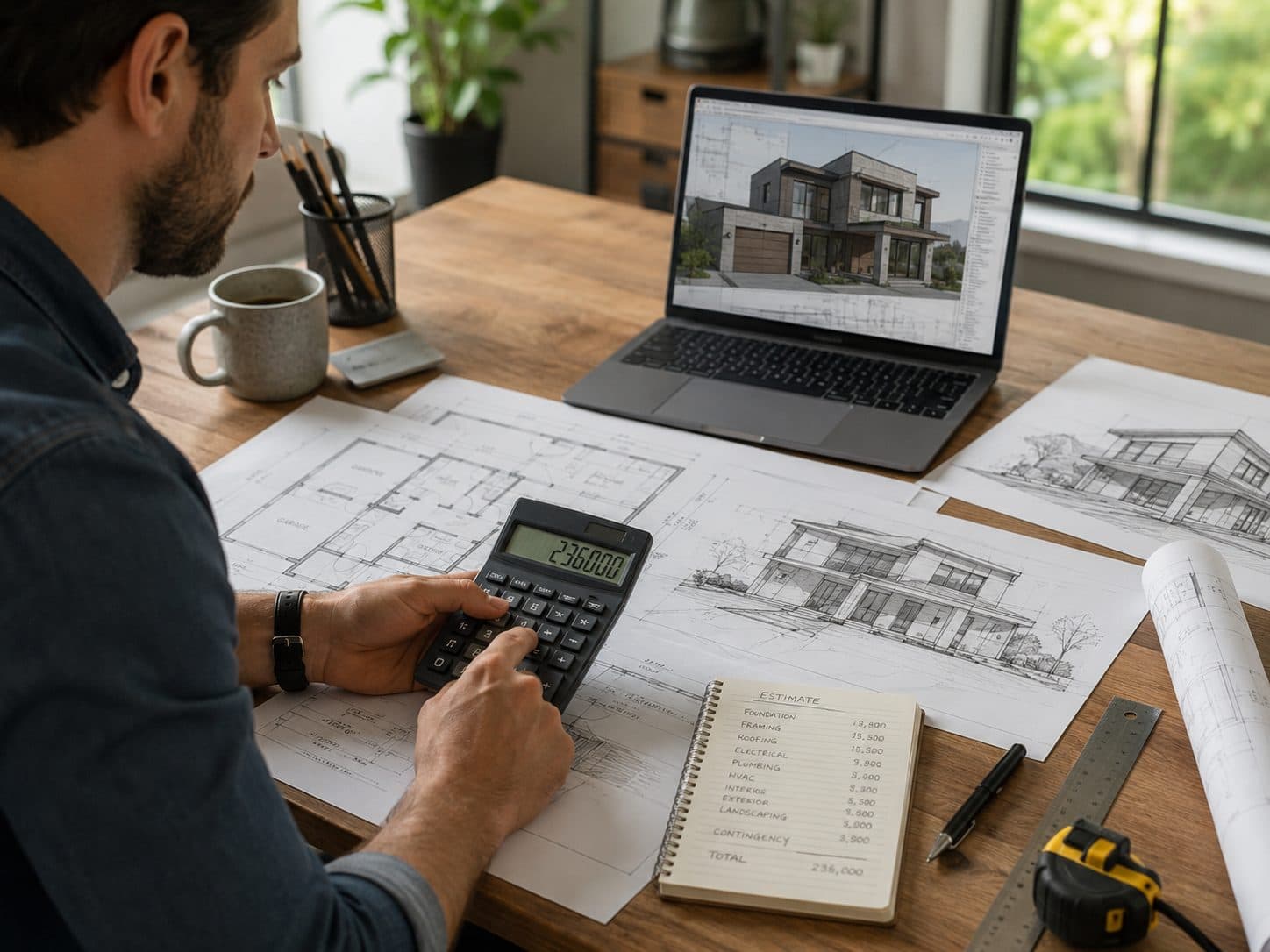
Why Custom Home Cost Is a Hard Question
I get asked this question more than any other, so I'm going to answer it honestly on a public page. Custom home cost is a hard question because the variables that move it are real — square footage, lot conditions, finish level, design complexity, permitting jurisdiction, and the labor and material market in any given month. But "it depends" is not a useful answer when you're trying to decide whether to start a project. So this post will tell you what custom home construction actually costs in Yamhill County right now, what drives the price, and what most builders won't bring up until the contract is in front of you.
Honest Per-Square-Foot Ranges in Yamhill County, 2026
Real custom homes in Yamhill County in 2026 are running roughly $400 to $700 per finished square foot for vertical construction. That's the cost of the building itself — foundation through finishes, including the architectural design, engineering, project management, and standard finish allowances. Most Creekside Homes projects land in the $500 to $700 per square foot range because of how we build (high-end finishes, integrated design-build, longer detailing time on every assembly). Cost-conscious custom builders working in the same region are sometimes $400 to $500 per square foot, often with simpler architectural language and a shorter design process.
Below $400 per square foot in this market in 2026, you're typically looking at production-style construction or builders with significant cost-cutting compromises in materials and crew quality. Above $700 per square foot, you're into the higher-end of the market — often homes with significant custom millwork, structural steel, large openings, or unusual material specifications. Where your project lands depends on the design, the lot, and the priorities you bring to the conversation.
What a Real Project Budget Actually Looks Like
Per square foot is a useful rough measure. It's not a useful contract number. The real budget for a Yamhill County custom home in 2026 typically looks like this for a 3,000-square-foot residence: $1.4M to $1.8M for vertical construction at the middle of the cost band, plus $80K to $200K for site development on rural acreage, plus $25K to $60K for specialty allowances and selections that exceed standard packages, plus $20K to $40K in design fees, surveying, geotech, and permit fees.
Total project cost for a thoughtfully built 3,000-square-foot rural home in Yamhill County in 2026 is therefore generally in the $1.6M to $2.1M range. A 4,500-square-foot home with similar finish level and similar site conditions runs $2.2M to $3.0M. These are honest ranges, not sales numbers — and they reflect actual projects we've quoted in the last six months.
What Drives Custom Home Cost
The single biggest factor that moves cost is finish level — and most clients underestimate it. Cabinetry, countertops, flooring, lighting fixtures, plumbing fixtures, appliances, and tile selections together can swing a project's total cost by $150K or more on a mid-sized home, depending on whether you're choosing standard mid-range packages or high-end custom selections. Material substitutions feel like small decisions in isolation. They're not.
The second biggest factor is design complexity: large clear-span openings, structural steel, multi-story atriums, complicated rooflines, and exterior elevation changes all carry cost premiums that compound through the build. The third factor is site work, which I'll come back to. A simple plan on a flat city lot with mid-range finishes is dramatically cheaper than the same plan on rural acreage with high-end finishes, even though the floor plan looks identical on paper.
Rural Site Development: Where Cost Surprises Live
Rural site development is where most cost surprises live. A rural Yamhill County lot — typical of the parcels our clients buy in the Chehalem Mountains, the Eola Hills, or out toward the coast range — generally needs a well ($15,000 to $25,000), a residential septic system ($20,000 to $40,000 for standard, $50,000+ for sand-filter or alternative treatment systems on poorer soils), power line extension ($10,000 to $50,000+ depending on distance from the road), driveway construction ($5,000 to $30,000), surveying and geotechnical work ($5,000 to $15,000), and site clearing and grading (highly variable, often $5,000 to $30,000).
Add permit fees and any system development charges and you're at $80,000 to $200,000 of cost before the foundation is poured. None of this is hidden — it's all knowable when we walk the lot. But it doesn't always show up clearly in early conversations with builders, and a rude awakening at month four of design is one of the worst experiences a custom home buyer can have.
City Lots vs. Rural Acreage: The Cost Difference
City lots in McMinnville, Newberg, Dundee, Carlton, Dayton, and Sherwood avoid most of those rural site costs because municipal water, sewer, and power are typically at the property line. They have their own cost characteristics: higher land cost per acre, smaller buildable footprints, sometimes restrictive HOA architectural review, and higher per-lot system development charges (often $10,000 to $25,000 in McMinnville and Newberg in 2026).
Demolition costs apply if there's an existing structure on the lot. But the total cost-from-zero on a city lot is often $100,000 to $150,000 less than on equivalent rural acreage when the home is the same. That cost difference is part of why some clients choose city lots even when their preference would be rural — it leaves more budget for the home itself.
Where Creekside's Clients Typically Land
Most of our clients hire us because of how we run a project, not because we're the cheapest. We're not. Our integrated design-build model has real cost — design fees that look higher than what an architect-only firm charges, longer detailing on every assembly, in-house project management that stays on every job site, and the kind of finish-level commitment that doesn't value-engineer the architecture in the field.
What that buys you is a home that gets built the way it was designed, a single accountable team when something needs to change, and an experience where you don't have to manage thirty subcontractors yourself. If those things matter to you, we're the right partner. If price is the primary lever, there are good production builders and good cost-conscious custom builders in this market and we'll cheerfully send you to a few. The honest fit conversation happens at the first meeting.
What to Ask Any Custom Home Builder
There are a handful of questions every prospective custom home buyer should ask any builder they're talking to in this market in 2026. What is your per-square-foot range for vertical construction, and what's included? What does a standard finish allowance look like? Can I see a sample line-item allowance schedule from a recent project? What does your contract look like — fixed-price, cost-plus, or guaranteed maximum price? Who manages the project day-to-day and how often will I hear from them?
What happens when something needs to change in the field — and can I see a real change order from a recent project? Who handles permitting, and how much of it falls on me? What's your typical timeline from first design meeting to keys, and where are the most common delays? What warranty do you provide, and what does claim resolution look like in practice? If a builder can't answer those questions clearly and confidently, that's information.
How to Get a Real Number for Your Specific Lot
If you own land in Yamhill County and you're trying to figure out whether your project is realistic at the cost ranges in this post, the cheapest, fastest answer is a paid site evaluation. We do these for prospective clients regularly — usually $3,000 to $8,000 depending on the lot — and we credit it back against the design fee if you move forward.
The evaluation tells you whether your soils support a standard foundation, whether septic is viable, what the well situation looks like in your specific area, what the permitting timeline will realistically be, and what the rough total project cost lands at for the kind of home you're describing. It is the single best dollar a custom home buyer spends. Most of the people we end up working with started with one. If you want to talk through your specific situation, the contact form on this site or a direct call to (503) 461-7046 is the easiest way to start.
Frequently Asked Questions
What does it cost to build a custom home in McMinnville, Oregon in 2026?
A typical 3,000-square-foot custom home in McMinnville in 2026 runs roughly $1.4M to $2.1M total, depending on whether the lot is municipal or rural and on finish level. Vertical construction is generally $400 to $700 per finished square foot. City lots in McMinnville tend to land at the lower end of that range; rural Yamhill County properties with full site development typically run higher.
How much does it cost per square foot to build a custom home in Yamhill County?
Real custom home construction in Yamhill County in 2026 runs $400 to $700 per finished square foot for vertical construction. Most Creekside Homes projects land in the $500 to $700 per square foot range. Below $400 per square foot in this market typically indicates production-style construction or significant cost-cutting compromises; above $700 per square foot indicates high-end custom finishes or unusual structural complexity.
What hidden costs come with building on rural Oregon land?
Rural site development typically adds $80,000 to $200,000 to a residential build before vertical construction starts. The major line items are well drilling ($15,000–$25,000), septic installation ($20,000–$40,000+ depending on soil quality), power line extension ($10,000–$50,000+ depending on distance), driveway construction ($5,000–$30,000), surveying and geotechnical work ($5,000–$15,000), site clearing and grading, and permit fees. Every line is honestly estimable for a specific lot once we've walked it.
Why do custom homes in Oregon cost more than production homes?
Custom homes are designed specifically for one family on one lot, with architecture shaped by the site's particular conditions. Production homes are built from fixed plans that the builder offers across many homesites with limited customization. The differences include design fees, longer detailing time on every assembly, lot-specific engineering, finish-level upgrades that aren't part of standard production packages, and the integrated project management that runs throughout. The price difference reflects real differences in product, not arbitrary markup.
What is a fair design fee for a custom home in Oregon?
Design fees vary by builder model. Architect-only firms typically charge 8% to 15% of construction cost. Integrated design-build firms like Creekside roll design into a unified contract with design fees in the $20,000 to $60,000 range for typical projects, often credited against vertical construction or absorbed into the total project cost. The right way to compare is total project cost from concept to keys, not isolated design fees, because design-build models often have lower coordination cost downstream.
How long does it take to build a custom home in Yamhill County?
Plan on twelve to twenty-four months from the first design conversation to keys. Design typically runs two to four months, permitting two to twelve weeks (depending on jurisdiction), and construction eight to fourteen months depending on size and complexity. Rural Yamhill County projects with significant site work tend to run on the longer end. We are honest about timeline at the first conversation — schedule realism is one of the things we protect carefully.
What's the cheapest way to build a custom home in Oregon?
The cheapest way is to start with one of a builder's existing floor plans, build on a city lot with utilities at the property line, choose mid-range finish allowances, and avoid structural complexity. Cost-conscious custom builders in this market in 2026 can deliver well-built homes in the $400 to $500 per square foot range under those conditions. "Cheapest" and "best fit" aren't the same thing — the right builder for you depends on what you actually want from the home, not just what you want to pay for it.
Should I build a custom home or buy an existing home in Yamhill County?
It depends on what's available, your timeline, and what you actually want from the home. Existing inventory in Yamhill County in 2026 is limited and what's on the market is often priced at or above what equivalent custom construction would cost. Custom homes deliver something existing inventory rarely does: a home designed for your specific lot, your specific family, and the way you actually want to live. The right answer for you is a real conversation about budget, timeline, and the parts of "home" that matter most.
The Building Journey
See how we design and build your home, step by step.
Floor Plans
Browse 15 customizable designs from 1,635 to 5,628 sq ft.
Service Area
We build across Yamhill County, Sherwood, Hillsboro, and wine country.
Ready to Talk About Your Project?
Get expert guidance from Oregon's trusted custom home builder.